
Local Column
COLUMN

About Mangrove in Ishigaki Island and Iriomote Island! Popular mangrove tours! Ishigaki Island resident staff will give you a thorough explanation!
Hello everyone!
Did you know that there are mangroves in Japan as well?
Ishigaki Island, part of the Yaeyama Islands—the southernmost archipelago in Japan—has a subtropical climate, which is unusual for Japan. Due to this distinctive climate, unique flora and fauna thrive there. Mangroves are one such example.
“Mangroves” further reinforce the image of a tropical destination. Since you can see various types of mangroves on Ishigaki Island, it might be worth making a visit there one of the highlights of your trip.
In this article, we’ll introduce you to the mangroves of Ishigaki Island.
Table of Contents
Characteristics of the Mangroves on Ishigaki Island

As explained at the beginning, Ishigaki Island has a subtropical climate, which is why mangroves grow in dense stands there.
"Mangrove" is a general term for trees that grow naturally in brackish waters near river mouths in tropical and subtropical climates. So, there isn't actually a specific tree called a "mangrove."
Ishigaki Island, which is part of the Yaeyama Islands, is home to many Yaeyama mangroves, as well as other species such as the common mangrove and the black mangrove.
In Japan, mangroves grow naturally south of Yakushima Island in Kagoshima Prefecture, and 30 species have been identified. It is said that there are over 100 species of mangroves worldwide.

Mangroves grow in brackish waters where freshwater and seawater mix, and their main difference from other plants is that they can grow even in seawater.
Mangroves can grow in seawater because they absorb seawater through their roots and excrete only salt through their roots and leaves. If you look at the underside of their leaves, you might see clumps of salt attached, so it’s worth taking a look.
Another distinctive feature is that it tastes salty when you bite into it.
Why the Mangroves on Ishigaki Island Are Worth Visiting

Ishigaki Island is renowned throughout Japan as a prime spot for mangroves, and their distinctive appearance and lush greenery have a presence that enriches the hearts of all who see them.
Since they grow wild near river mouths and along the coast, you can spot them while taking a walk or a drive in the area. If you’d like to observe them up close,canoeand ... andSUPIt might be a good idea to try participating in activities like these.

In the Yaeyama Islands, including Ishigaki Island, you can see about eight different species of mangrove trees, and one of the highlights is observing how the vegetation changes depending on variations in salinity—from saltwater to brackish water to freshwater.
Many of them have been reshaped by the mangroves, and some have interesting shapes.
Here are a few of the mangroves you can see on Ishigaki Island.
Mangroves on Ishigaki Island (Part 1): Yaeyama Mangrove

The first mangrove I’d like to introduce is the Yaeyama mangrove.
Yaeyama Hirugi is the most abundant native mangrove in the Yaeyama Islands. As it sucks up seawater from its roots, it accumulates salt in its teeth near the tips of its branches, and when it reaches its upper limit, the entire leaf itself falls off.
The color of the leaves can be used to determine if they contain salt. The leaves are originally green, but as they contain salt, they change color to yellow.
Because it grows naturally in waters with a large tidal range, it develops a sturdy, elevated root system known as prop roots. Since there are occasional gaps between the roots, they serve as habitats for various organisms, playing a role in providing ecosystem services.
Mangroves on Ishigaki Island, Part 2: Rhizophora

There is one major difference between the Japanese hirugi and the Yaeyama hirugi. It is in the shape of its roots.
While Yaeyama hirugi is shaped like an octopus foot on stilts, the roots of Ohirugi resemble a bent knee.
Because of this characteristic, it is called "knee-root.
During a mangrove cruise at low tide, you can see their knees sticking out of the water.
Unlike the Yaeyama mangrove, which has roots firmly anchored in the ground, this plant grows close to the surface.
Mangroves on Ishigaki Island, Part 3: Rhizophora

The mehirugi is a mangrove species that is paired with the mangrove Ojirugi, with Ojirugi being labeled "male" and mehirugi being labeled "female.
The mehirugi was given this name in comparison to the Nakaohirugi because it has a slender trunk and beautiful flowers that are more feminine than the Ohirugi.
This mangrove is particularly cold-hardy among mangroves and is commonly found not only on Ishigaki Island and Iriomote Island but also on other remote islands.
The flowers are so cute—you’d never guess they’re from a mangrove tree—so be sure to check them out.
Mangroves on Ishigaki Island, Part 4: False Mangrove

The last mangrove I’d like to introduce is the false mangrove.
The Hirugi damashi does not belong to the Hirugiaceae family, which includes Yaeyamahirugi, Ohirugi, and Mehirugi, but it can tolerate seawater, so we named it Hirugi damashi with "damashi," meaning closely related.
As its English name, ”pencil root,” suggests, this plant is characterized by its slender, pencil-like stems that stand upright out of the water.
You can spot them growing here and there in Nagura Bay, the largest bay on Ishigaki. Since they grow in fewer areas than other species, be sure to keep an eye out for them.
Top 3 Mangrove Spots on Ishigaki Island
There are several spots on Ishigaki Island where you can see mangroves. It is generally said that they grow in brackish water areas where river water and seawater mix.
Here, we’ll introduce some of Ishigaki Island’s mangrove spots.
Mangrove Spots on Ishigaki Island, Part 1: Fukidori River

The first mangrove spot I’d like to introduce is the ”Fukidori River.”
The Fukidori River flows through the Hirakubo Peninsula area of Ishigaki Island and is home to a colony of mangroves, which are designated as a National Natural Monument. This colony is said to be one of the largest mangrove forests on Ishigaki Island.
To access the mangroves along the Fukitsugi River, park your car at a parking lot near the Fukitsugi Bridge and follow the stairs leading down to the river. At low tide, the mangrove roots become exposed, so be sure to check the tide table beforehand.
Address: Nosoko, Ishigaki City, Okinawa Prefecture
Phone: 0980-82-2809
Mangrove Spots on Ishigaki Island, Part 2: Miyara River

The Miyara River boasts the largest watershed area on Ishigaki Island, and mangrove forests stretch for approximately 1.5 km along its estuary.
The scenery, surrounded by vast rivers and mangroves, is spectacular. Since it’s such a large area, many activities are offered there.
Take a cruise on a SUP or canoe and see for yourself how the mangroves spread their roots like octopus legs!
You can observe the mangroves and the wildlife from the top of the Miyara Bridge, but since you’re here, why not take the opportunity to experience some activities and get a closer look at the mangroves?
Address: Miyara, Ishigaki City, Okinawa Prefecture
Phone: 0980-82-2809
Mangrove Spots on Ishigaki Island, Part 3: Nagura Bay

The last mangrove spot I’d like to introduce is ”Nagura Bay.”
Nagura Bay is the largest bay on Ishigaki Island, stretching across the southwestern part of the island, and is easily accessible—it’s about a 20-minute drive from downtown.
While it is known as an area where mangroves grow naturally, it is also famous for its high biodiversity, featuring coral and tropical fish in the sea, as well as tidal flats around the bay.
For this reason, this entire area is protected under the Ramsar Convention.
The most distinctive feature of Mezo Bay is its stunning sunsets. Because it opens up to the west, the sun sinking into the sea on the horizon creates a truly beautiful, picturesque scene.
During the day, you can observe plants and animals in the mangroves and mudflats, and then watch a beautiful sunset in the evening to round off a perfect day.
Address: Nagura, Ishigaki City, Okinawa Prefecture
Phone: 0980-82-2809
Recommended Activities in the Mangrove Forests of Ishigaki Island
So far, we’ve introduced you to the mangroves of Ishigaki Island and the spots where they grow naturally. Now, we’d like to tell you about some activities that will help you enjoy these mangrove spots even more.
Ishigaki Island Mangrove Activities #1: Fukidori River SUP Tour

The first activity I’d like to introduce is ”Fukidori River SUP.”
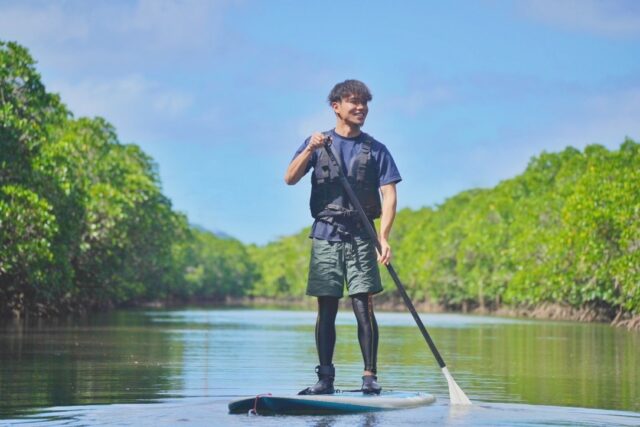
Compared to the Miyara River, the Fukidori River is a more compact waterway. This makes it ideal for SUP cruising, as the maneuverability of the board allows you to easily avoid obstacles. Additionally, if you spot fish or other wildlife, you can paddle right up to them to get a closer look, so I highly recommend trying SUP on the Fukidori River.
I think even among those with SUP experience, many have only ever tried it in the ocean, so this might be a good opportunity to give SUP a try surrounded by greenery.trekkingLet's have fun, too!
Mangrove Activities on Ishigaki Island, Part 2: Fukidori River Canoe Tour

The next mangrove activity we’d like to introduce is ”Canoeing on the Fukidori River.”
Tours on the Fukidori River typically head upstream from the mouth of the river. Since you’re traveling from the ocean toward the river, you’ll see a variety of mangroves due to differences in salinity. Also, while it’s not too strenuous, heading upstream does require a certain amount of stamina. In that regard, canoes provide more propulsion than other activities, and since two-person canoes are available, you can share the physical effort as you paddle upstream.
Once you reach the upper reaches, you’ll trek further upstream toward your destination, Yabiku Falls. Yabiku Falls is also known as the “Matchmaking Falls” and is famous as a power spot for romance.
Only a canoe trip on the Fukidori River lets you leisurely enjoy the mangroves on your way to a spiritual spot!
Ishigaki Island Mangrove Activities #3: Miyara River SUP Tour

Next up on our list of mangrove activities is ”Miyara River SUP.”
Because the Miyara River has the largest watershed area on Ishigaki Island, you can enjoy a wide variety of activities with plenty of freedom in its vast surroundings. In particular, SUP—with its many different ways to paddle and play—is a perfect match for this open, versatile environment.
Also, since the natural scenery is so beautiful, SUP—a trendy activity—makes for some great photos.
Let's take lots of photos on our mangrove SUP tour!
Mangrove Activities on Ishigaki Island, Part 4: Miyara River Canoe Tour

Canoeing on the Miyara River is definitely the quintessential activity on Ishigaki Island.
It’s my first time on a jungle cruise—it has a great atmosphere, but some people might find it a little scary and get their hearts racing.
However, the kayaks used for the river kayaking tour activity are extremely stable and buoyant, so it’s very rare for them to capsize or sink.
That’s why even young children and those who aren’t strong swimmers can participate with confidence. In particular, if you’re traveling with young children, we have two-person kayaks available, so you can ride with your child—which should give you peace of mind!
Be sure to enjoy a jungle cruise at Japan’s No. 1 resort destination.
Also,If you're planning to take a trip from Ishigaki Island to one of the outlying islands,Ferry Ticketsschool (e.g. of ikebana)Buy OnlineIt is convenient to do so.
Since payment is made in advance, all you need to do on the day of your trip is show your smartphone to board. During peak seasons like spring break and Golden Week, ferry ticket counters can get so crowded that long lines form, but if you purchase your tickets online in advance, you won’t have to worry about getting caught up in the lines at the ticket counter on the day of your trip. You can enjoy a smooth and stress-free trip. Since the plant life differs between Ishigaki Island and Iriomote Island, it’s fun to tour the outlying islands and discover the unique scenery and townscapes each one has to offer. Please check out the information below for more details ↓
Ishigaki Island Mangrove Activities #5: Sunrise SUP/Canoe Tour

On the sunrise SUP tour through the mangrove forests of Ishigaki Island, you can enjoy the sight of the sunrise along with the mangroves.
Also, since it takes place early in the morning, you can participate even on the very day you’re flying home.
Since you're on a trip to Ishigaki Island, it's nice to enjoy a few drinks and stay out late, but it's also a good idea to get up early at least one day and join a tour.
Since it's an early morning tour, the fact that it tends to be less crowded is one of the reasons it's so popular!
Mangrove Activities on Ishigaki Island ⑥ Sunset SUP/Canoe Tour

On the Sunset Tour, you can enjoy a SUP or canoe cruise through the mangrove forests while watching the sunset.
The sunsets on Ishigaki Island are especially beautiful because the air is so clear. It’s also nice to watch them while lying back on a SUP.
Plus, you can head straight out for dinner after the tour ends!
in the end

We’ve introduced you to the mangroves of Ishigaki Island. What did you think?
As the southernmost resort destination in the country, it truly offered a unique atmosphere and breathtaking views. We’ve mainly introduced spots and activities where you can fully enjoy the mangroves. Did any of these spots catch your interest? Be sure to pay them a visit.
Thank you for reading to the end.
This article was written by.