
Local Column
COLUMN

All About the Mangrove Groves Along the Fukidori River—One of Ishigaki Island’s Top Tourist Attractions! Our Ishigaki-based staff will give you the full scoop!
Hello everyone!
Ishigaki Island is one of the remote islands belonging to the Yaeyama Islands, the southernmost archipelago in Japan, and its unique subtropical climate supports a diverse array of flora and fauna. Mangroves, a quintessential subtropical plant, grow in dense stands here. The plants that make up these mangrove forests are primarily members of the Rhizophora family. This mangrove community has been designated as a National Natural Monument.
In this article, we’ll introduce the mangrove groves along the Fukidori River.
Table of Contents
About the Mangrove Groves Along the Fukidori River

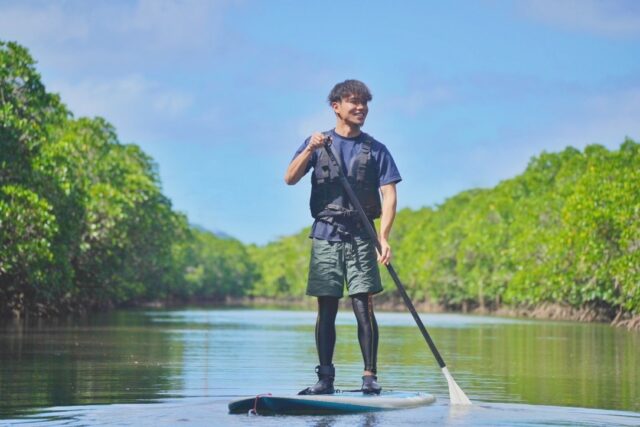
Near the mouth of the Fukidori River, located in the northern part of Ishigaki Island, there is a mangrove grove. Since there is a parking lot at Fukidori Bridge, you can stop by to see the mangroves while out for a drive. From the parking lot, follow the stairs leading down to the riverbank, and you’ll see the mangrove grove right away. At low tide, the water recedes, allowing you to observe the mangrove roots and walk around the area. On the mudflats, crabs were scurrying about, and gobies were hopping around. Here,SUPand ... andcanoeYou can enjoy a game that involves a cruising experience. If you go upstream, there’s a waterfall, and you can play in the water at the base of the falls.trekkingYou can do that, too!
Directions to the Mangrove Grove along the Fukidori River

The Fukidori River flows through the Hirakubo Peninsula, which juts out from the northeastern part of Ishigaki Island. As a result, it is located near Itona Beach, north of Prefectural Route 79. Just before the bridge spanning the Fukidori River, on the right-hand side, there is a free parking lot called the Fukidori Bridge Parking Lot. From the parking lot, you can access the mangrove grove.
Detailed Information on the Mangrove Groves Along the Fukidori River

The Fukidori River is a 2.2-kilometer-long river that originates at Mt. Nosoko, famous for the Mape legend. Since it is smaller than Miyara River—the island’s largest river—it is easy to travel from its mouth all the way upstream. Near the mouth of the Fukidori River, in the brackish waters where freshwater and seawater mix, there is a vast mangrove forest dominated by Rhizophora trees. “Mangroves” is a general term referring to plants that grow naturally in the intertidal zone—areas such as tropical and subtropical estuarine wetlands and coastal tidal flats—which are highly susceptible to the effects of the tides.

The mangroves along the Fukitsugi River are predominantly composed of plants from the Rhizophora family—such as Yaeyama Rhizophora, Ohirugi, and Mehirugi—many of which are designated as National Natural Monuments. This mangrove community serves as an extremely valuable habitat and nesting site for wildlife, including wild birds. In the river, shrimp, crabs, and fish migrate between the sea and the river with the ebb and flow of the tides. The mangroves of the Fukidori River, which support the river’s ecosystem, include the following plants:
Yaeyama Higi
The Yaeyama mangrove is one of the most commonly seen mangrove species on Ishigaki Island. The mangrove we typically imagine—with roots that look like octopus legs—is the Yaeyama mangrove. This species draws up brackish water and stores some of it in its leaves. When the water reaches its limit, the leaves turn yellow and fall plop into the river.
Mangrove Impostor
Although the false mangrove isn’t as common as the Yaeyama mangrove, you can occasionally spot it growing here and there in brackish water areas closer to the sea. With its charming, soothing appearance, it also serves as an ornamental plant.
Mangrove
Unlike the Yaeyama mangrove, whose roots are shaped like octopus legs, the roots of the Ohirugi mangrove—which are exposed at low tide—are shaped like knees. Because of this knee-like shape, they are called ”knee roots.”
Mangrove
The Mehirugi was given its name in contrast to the Ohirugi because its roots are thinner and it produces more beautiful flowers. Since the Mehirugi is cold-hardy, it grows not only in the Yaeyama Islands—such as Ishigaki Island and Iriomote Island—but also in other areas.
Litsea coreana (species of tree in the laurel family)
The Sashima suou tree is a plant found in wetlands where mangrove forests grow naturally, but strictly speaking, it is not classified as a mangrove. Since it can be spotted in the same area, I’d like to introduce it here. Some trees are over 400 years old, making them truly impressive. Be sure to look for them when you visit the mangrove grove.
Modama Tree
The modama tree is a plant that bears giant beans, which served as the inspiration for ”Jack and the Beanstalk.” You can see one during the Fukidori River tour, so be sure to check it out.
How to Enjoy the Mangrove Groves Along the Fukidori River

The main ways to enjoy the mangrove forests along the Fukidori River are SUP and canoe cruising, as well as hiking. The Fukidori River, with its lush mangrove forests, is located within the Iriomote-Ishigaki National Park. Cruising through the mangroves offers an experience straight out of a movie. After finishing the mangrove cruise, you’ll hike to Yabiku Falls, also known as a “power spot” for romance. Paddling down the river on a SUP and then hiking through the lush vegetation to reach the waterfall offers an incredible sense of accomplishment when you finally catch sight of it! Be sure to recharge your energy fully!
What to Wear When Entering the Mangrove Forest
There is a chance you may get splashed while canoeing or near the waterfall pool. Therefore, we recommend wearing clothes that you don’t mind getting wet or dirty. If you plan to participate in the hike, it’s best to wear non-slip shoes. Also, although the area is surrounded by mangroves, the sun shines down strongly from above. Be sure to bring a hat and sunscreen.
Address: Nosoko, Ishigaki City, Okinawa Prefecture
Directions: About a 20-minute drive from New Ishigaki Airport; about 35 minutes from the Ishigaki Port Remote Islands Terminal
Hours of operation: None
Usage fee: Free of charge
Phone number: 0980-82-1535 (Ishigaki City Hall Tourism and Culture Division)
Parking : Available
Toilet: None
summary

We’ve introduced the mangrove grove along the Fukidori River. What did you think?
As we’ve seen, the Fukidori River—where various mangrove species grow in dense stands—is a very important place for both wildlife and the people who use it. Here are some highlights of the mangrove communities along the Fukidori River:
・Birdwatching for species such as the Crested Eagle
・Power Spots for Love
・Various types of mangrove plants
・A wide variety of wildlife
Be sure to keep the above points in mind and pay a visit to the mangrove grove along the Fukidori River.
Thank you for reading to the end.
This article was written by.