

Local Column
COLUMN
How to Get to and Enjoy the Nio Statues at Torin-ji Temple, a Tourist Attraction on Ishigaki Island
Hello everyone!
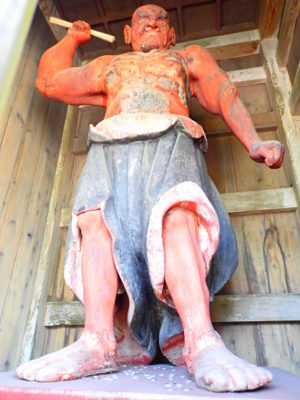
The Yaeyama Islands, including Ishigaki Island, are home to numerous historical sites unique to the region. The Nio statues at Tōrin-ji Temple on Ishigaki Island are said to be the oldest surviving wooden sculptures in Okinawa. Although these Nio statues are truly imposing, they still stand today at the temple’s main gate after weathering various historical events. In this article, we’ll introduce you to these historic Nio statues at Tōrin-ji Temple.
Table of Contents
About the Nio Statues at Tōrin-ji Temple
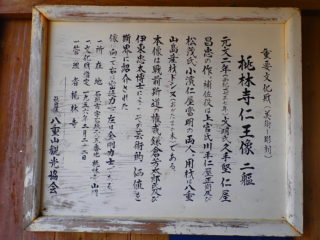
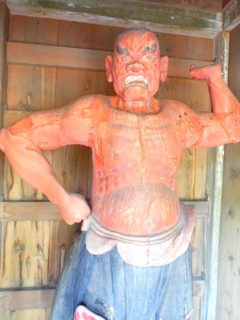
The Nio statues at Tōrin-ji Temple are the two oldest wooden statues in Okinawa Prefecture, located at the temple’s Sanmon gate. Facing the Sanmon gate, the statue on the right is the Mitsujiki Rikishi, and the one on the left is the Kongō Rikishi. They were carved in 1737 by Kudehata Masatada using Ogatamakino wood sourced from the Yaeyama Islands. Shortly thereafter, they were swept away and damaged by a massive tsunami, but were later recovered, restored, and returned to the mountain gate in their current form. Their visual presence conveys a sense of strength—the resilience to return even after being swept away by a tsunami. Their imposing and awe-inspiring presence is a source of great power.
Directions to the Nio Statues at Tōrin-ji Temple

Exit the Ishigaki Island Remote Islands Terminal and go straight down the road on your left. Turn left onto City Hall Street and continue straight. Turn right onto Tōrin-ji Nishi Street and continue straight for a short distance; you’ll see the Tōrin-ji Niō statues on your right.
Detailed Information on the Nio Statues at Tōrin-ji Temple
Tōrin-ji Temple is located in the southern part of Ishigaki Island, near the Remote Islands Terminal. It is said that, since there were no temples or shrines in the Yaeyama Islands, the Ryukyu Kingdom established this temple in 1614 as a temple of the Myōshin-ji branch of the Rinzai school of Zen Buddhism, following a recommendation from the Satsuma Domain. It is considered the oldest wooden structure and the oldest temple in Okinawa. Furthermore, in 1737, the Tōrin-ji Niō statues—the oldest wooden sculptures in Okinawa—were enshrined at the temple’s main gate. In 1956, the Tōrin-ji Niō statues were designated as Tangible Cultural Properties of Okinawa Prefecture, and the adjacent Gongen-dō Hall was also designated as an Important Cultural Property of Japan.
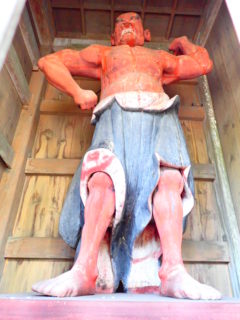
During the Meiwa Tsunami of 1771, both Nio statues were swept away, and both Tōrin-ji Temple and the Gongen-dō Hall were severely damaged. They were later restored; the Tōrin-ji Nio statues that had been swept away were found washed up on the shore of Saki-eda Bay with their limbs broken. They have been fully restored and reinstalled at the mountain gate of Tōrin-ji Temple.
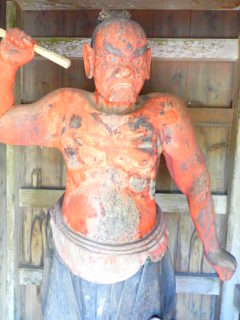
The mountain gate features a distinctive red-tiled roof that evokes the essence of Okinawa. Once you pass through the mountain gate and enter the main hall of Tōrin-ji Temple, the serene atmosphere and soothing silence—born of a history spanning some 400 years—will leave you feeling refreshed in both body and mind. Within the temple grounds, you’ll find banyan trees said to be the home of the Kijimuna, a type of fairy, and you can also receive a temple stamp (goshuin).
After taking in the imposing presence of the Nio statues, let’s go get a goshuin from Japan’s southernmost temple!
How to Play with the Nio Statues at Tōrin-ji Temple
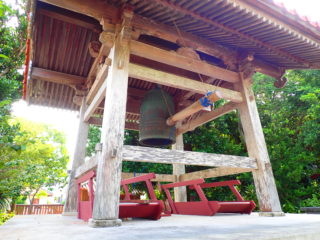
The Sanmon Gate, where the Nio guardians of Tōrin-ji Temple are enshrined, naturally leads to Tōrin-ji Temple itself. Tōrin-ji Temple is known for having the second-highest number of visitors for Hatsumōde (New Year’s visits) on Ishigaki Island. As a result, it gets particularly crowded with locals and tourists during the year-end and New Year’s holidays. Since Ishigaki Island is surrounded by the sea and fishing is a thriving industry there, many people come to pray for a bountiful catch. There’s also the Gongen-dō Hall and the Chinese Tomb, so it’s a great idea to visit them all as part of your sightseeing tour.
Since Tōrin-ji Temple is very close to the city center and the remote island terminal, it might be a good spot to drop by on a whim while you’re waiting for a ferry to one of the remote islands. When you actually visit the Niō statues at Tōrin-ji, you’ll notice the distinctive red-tiled mountain gate where they’re enshrined. Amulets are sold at the entrance, so you can easily pick one out and purchase it. It’s quite interesting that the custom here is to place the cost of the amulet directly into the offering box. There are also plenty of cafes and restaurants nearby, so it’s a great idea to stop by for a stroll after a meal.
Address: 285 Ishigaki, Ishigaki City, Okinawa Prefecture
Directions: About a 15-minute walk from the Remote Islands Terminal; about a 20-minute drive from Ishigaki Airport
Parking: Available
Restaurant: Available
Toilet: None
summary
We’ve introduced the Nio statues at Tōrin-ji Temple. What did you think?
The Nio statues at Tōrin-ji Temple, which exude a sense of power, were a valuable cultural heritage site designated as a Tangible Cultural Property of Okinawa Prefecture.
Here are some highlights of the Nio statues at Tōrin-ji Temple:
・Stunning visuals
・Okinawa’s oldest wooden statue
・A mountain gate with red tiles, typical of the Yaeyama Islands
・Strength that can withstand even a tsunami
・Easy access to the Remote Islands Terminal
After checking the points above, be sure to pay a visit to the Nio statues at Tōrin-ji Temple.
Thank you for reading to the end.
This article was written by.